
Proxy Speed vs Success Rate: What Actually Matters for Sneaker Botting?

Success rate matters more than raw proxy speed for most sneaker botting setups. A 100 ms proxy that keeps getting blocked is worse than a 400 ms proxy that stays stable, matches the right region, and gets tasks where they need to go.
Speed still matters… It just isn’t the whole game.
Does Proxy Speed Actually Matter for Sneaker Botting?
Yes, proxy speed matters, especially when seconds separate stock from sold out. Lower latency means requests can reach the retailer and return faster, which can help during monitoring and time-sensitive checkout stages.
But latency only measures one part of performance. As we covered in our sticky vs rotating proxies guide, rotation and speed are separate variables. A huge rotating pool can still contain slow, unreliable, or wrong-region IPs.
So, if Proxy A responds in 100 ms and Proxy B responds in 400 ms, A wins the speed test. That doesn’t automatically mean it wins the drop.
Why Can a Slower Proxy Have a Better Success Rate?
A slower proxy can perform better when its IP reputation, location, and session stability are stronger. Retailers care about more than how quickly your connection responds.
TSB’s current Nike proxy guide specifically points to IP reputation, location, consistency, accounts, proxy quality, and the overall setup as relevant variables. It also notes that residential proxies can be slower than ISP options without automatically being the worse choice.
Here’s the difference:
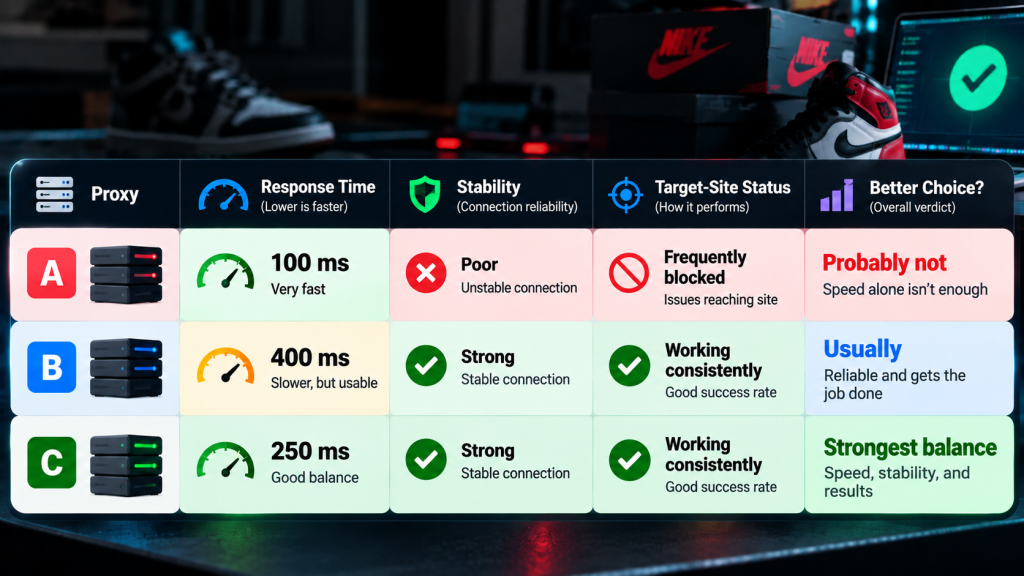
Those figures are examples, not universal benchmarks. The point is simple: latency means very little if the request gets rejected anyway.
What Proxy Metrics Matter More Than Speed?
The metrics that matter are response time, IP reputation, stability, location, and actual performance on your target retailer.
That last one is the biggie.
A proxy can look beautiful in a generic speed test and shit the bed when it meets the retailer you actually want to run. Wrong-region, dead, reused, or burned proxies can stall or time out tasks, which is why our sneaker bot error guide recommends testing proxies before a drop.
For account-based tasks, consistency may matter too. If a workflow expects one account to maintain the same session, constantly switching IPs can work against what you’re trying to achieve.
Should You Choose Proxies by Speed or Success Rate?
Choose proxies based on retailer-specific reliability first, then use speed to narrow down the best options.
Think of it like this:
Good IP + stable connection + correct location + acceptable speed > insanely fast IP that gets blocked.
That’s also why there isn’t one universally “best” proxy configuration. Nike, Shopify, monitors, account-linked tasks, and repeated-request workloads can behave differently.
If you’re still sorting out which proxy types fit each use case, our sneaker proxies guide covers the broader setup.
Proxy speed vs success rate isn’t really a 100 ms versus 500 ms argument. The proxy that consistently completes the job is more useful than the proxy that wins a speed test. Start with clean, stable, correctly located IPs. Then optimize latency once the fundamentals actually work.
Fast Isn’t Everything: It’s the Finish That Counts!
Speed can get you into the race, but results are what matter at the finish line. With 1M+ items secured and $50M+ in profit generated by members overall, TSB has the track record to back the talk.
If you’re ready to turn speed into opportunity when the next hyped drop takes off, make sure your TSB key is ready before the race begins.