
Why Do Sneaker Restocks Happen & How Do They Work?
Sneaker restocks happen when a retailer makes a sold-out shoe available again, either through newly allocated inventory, another planned stock release, or pairs that return to available inventory. And no, every restock doesn’t mean Nike suddenly made another million pairs overnight.
Some are planned months ahead. Others are tiny inventory reloads that disappear before most sneakerheads even know they happened. That difference is why one restock can feel like a whole second release while another gives you roughly enough time to blink and catch an L.
Why Do Sneaker Restocks Happen in the First Place?
Sneaker restocks happen because sold out doesn’t always mean the entire supply of a shoe is exhausted. Inventory can be released in stages, distributed across different retailers and regions, or become available again after the original drop.
Brands can also deliberately bring successful products back when demand remains strong. This is especially true for models that move beyond a single hype release and become reliable sellers.
The Nike Dunk Low Panda is probably the funniest example. TSB has already covered how the Panda went from hype sneaker and resale darling to a “cultural punchline” after Nike restocked it completely. Yet the black-and-white Dunk is still available in multiple markets in 2026.
So yeah, the Panda basically got restocked until the sneaker game started treating another Panda restock like a recurring calendar event.
Where Does the Stock in a Sneaker Restock Come From?
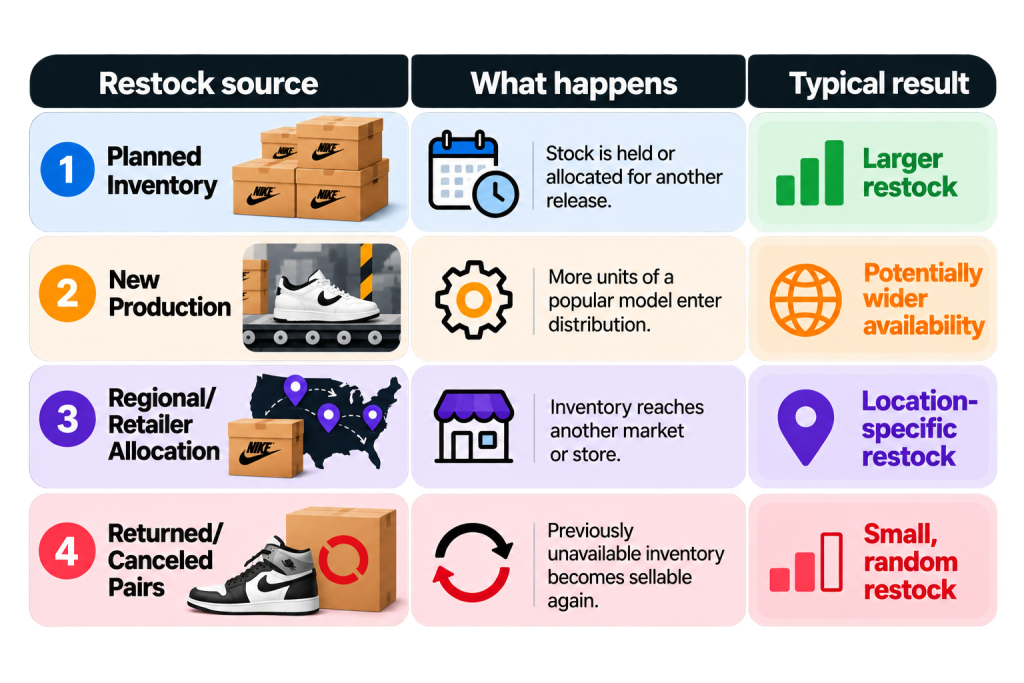
Restock inventory can come from several places, which is why not every restock has the same amount of stock.
That last category explains why monitoring matters. TSB’s 2026 guide to sneaker monitors notes that monitors can track inventory updates and restocks automatically instead of forcing you to refresh product pages all day.
And when only a few sizes reappear… those pairs can be gone stupidly fast.
Are All Sneaker Restocks Announced?
No. Sneaker restocks can be scheduled and public, or they can appear with little warning.
That distinction changes how you approach them. A scheduled restock gives everyone time to prepare, while a quiet inventory reload rewards whoever notices it first.
Nike Mind is a clean 2026 example. After its initial demand, Nike repeatedly brought Mind models back throughout the year. TSB covered one of those drops in our Nike Mind restock guide, while outside release tracking documented multiple Mind 001 restocks during 2026.
That is completely different from waiting for one giant second launch. Sometimes the real battle happens across several smaller restocks.
Does a Restock Work Like the Original Sneaker Drop?
A restock can use the same release system as the original drop, but the method depends on the retailer and release.
You might face first come, first served, a raffle, a queue, Exclusive Access, or another platform-specific method. TSB’s latest sneaker release methods guide breaks down how FCFS, raffles, and queues change who actually gets a shot at checkout.
Knowing that a sneaker is restocking is only half the job. You also need to know how it’s restocking.
For Nike releases specifically, our sneaker bot setup guide explains how to configure the accounts, proxies, profiles, and tasks needed to compete during limited releases.
Do Restocks Make Sneakers Less Valuable?
Restocks can put downward pressure on resale prices by increasing supply, but the effect depends on how much stock returns relative to demand.
A tiny restock of a heavily demanded Jordan isn’t the same thing as repeatedly flooding the market with a GR Dunk.
That’s why sneakerheads watch both sides of the equation:
More supply + unchanged demand = less scarcity.
Small supply + massive demand = scarcity can remain.
The Panda Dunk showed what happens at the extreme end. Constant availability helped turn a once-hyped shoe into something far more accessible. Nike Mind shows the other side: multiple 2026 restocks still faced enough demand for certain drops to sell through quickly.
So when a sneaker sells out, don’t automatically assume resale is your only option. The first drop can genuinely be just round one.
The Comeback Is Real: Don’t Miss Your Second Shot
The first drop might be over, but a restock can put the pair you missed right back within reach. With 1M+ items secured and $50M+ in profit generated by members overall, TSB has the track record to back the talk.
If the sneaker gem that got away comes knocking for round two, make sure your TSB key is ready before that second chance disappears.