
Bots for Shoes: The Truth, How They Work, and If They’re Legal
Over the past decade, the sneaker space has evolved into a serious, profit-driven resale market. Limited releases, massive demand, and online-only drops have turned exclusive items into real investment opportunities. This shift has fueled the rise of Bots for shoes. Those automated tools that give users the speed and scale needed to secure high-value products in seconds.
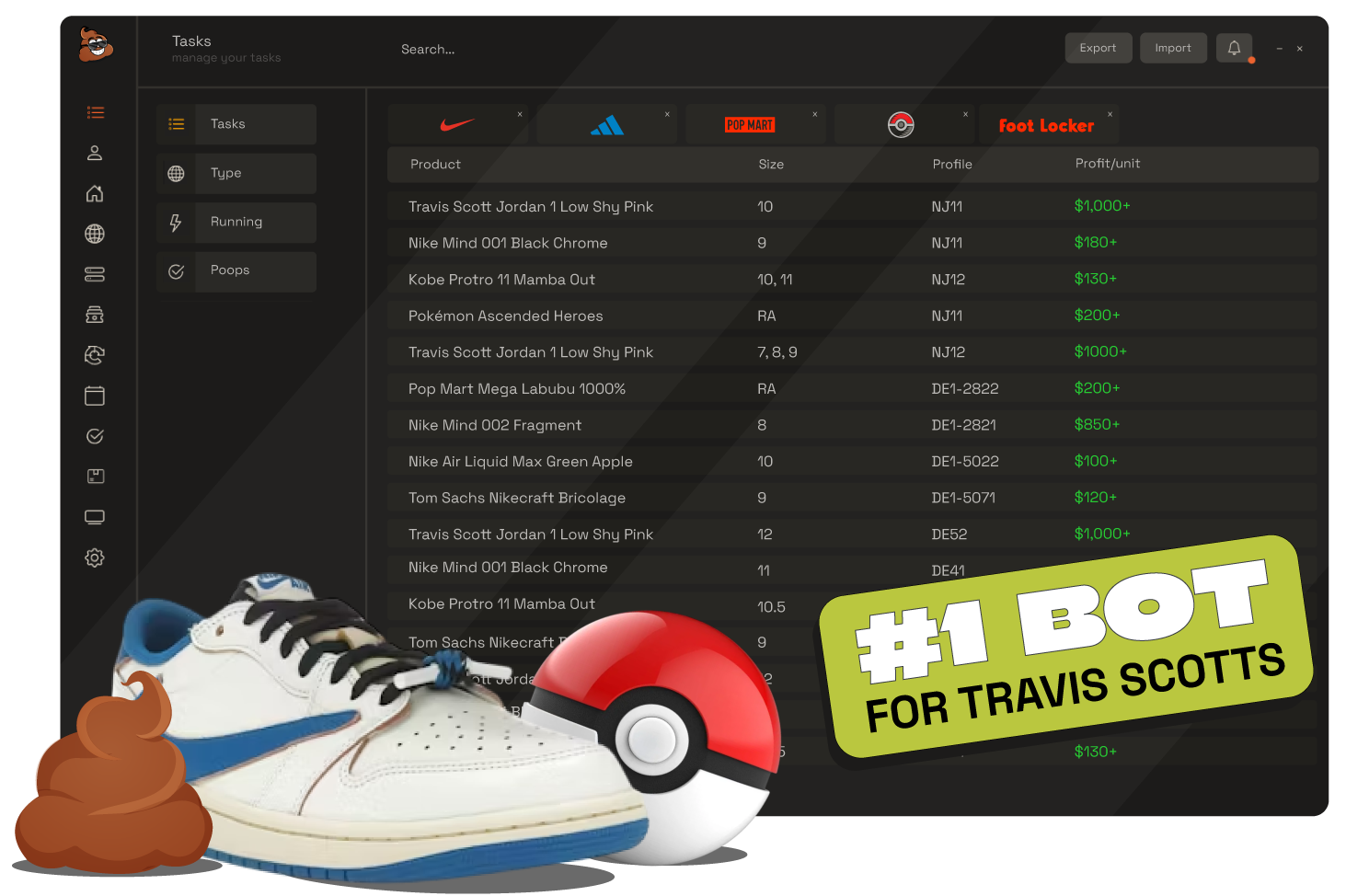
Today, bots aren’t just about convenience; they’re a gateway into reselling. From hyped releases like Travis Scott sneakers to trending pairs like Nike Minds, bots make it possible to consistently access inventory that’s nearly impossible to grab manually. Beyond sneakers, they also open doors to profitable collectibles such as Pokémon cards and Pop Mart figurines. And other items that can generate serious resale returns.
In this landscape, Bots for shoes have become powerful investment tools, enabling users to enter and compete in a market where speed, access, and timing directly translate into profit.
What Are Bots for Shoes?
Bots for shoes, commonly known as sneaker bots, are software programs that automate the process of purchasing sneakers online. Instead of manually refreshing a website and checking out, bots perform these actions instantly and repeatedly.
They are primarily used during limited releases on platforms like Nike SNKRS, Shopify stores, and major retailers.
How Bots for Shoes Work
Sneaker bots operate by mimicking and accelerating human actions during online checkouts:
- Monitoring: Tracks release time and product page
- Autofill: Instantly enters shipping and payment details
- Checkout: Completes purchase faster than manual users
- Multi-tasking: Attempts multiple checkouts simultaneously
Advanced bots can also bypass protections, rotate proxies, run hundreds of tasks, and solve CAPTCHA automatically. And this extreme speed advantage is exactly what makes Bots for shoes so effective, and so controversial.
When Bots for Shoes Become Necessary
There’s a point where manual effort simply isn’t enough, and that’s during ultra-limited, high-demand sneaker releases.
For the most exclusive drops, where stock is extremely low and demand is global, Bots for shoes aren’t just an advantage; they become a necessity. Even if you’re fast, you’re competing against thousands of automated checkouts happening in milliseconds.
Powerful solutions like The Shit Bot are built specifically for these situations. They allow users to run multiple tasks, scale entries, and actually compete in an environment where manual users realistically have near-zero chances. So in these cases, using bots isn’t about “getting ahead”; it’s about having a chance at all.
What Do the Biggest Sneaker Bots Have in Common?
The most successful Bots for shoes share key features:
- Speed optimization: Faster checkout = higher success
- Proxy support: Avoid bans and rate limits
- Multi-tasking: Hundreds of attempts at once
- Site compatibility: Works across multiple retailers
- Frequent updates: Adapts to anti-bot systems
These capabilities are what separate top-tier bots from the rest.
Examples of Popular Bots for Shoes
Some widely known Bots for shoes include:
- The Shit Bot
- Nikeshoebot
- Usnkrs
- CyberAIO
These tools have built reputations within sneaker communities due to their performance on hyped releases, though they are often difficult to access.
History of Bots for Shoes
The rise of Bots for shoes mirrors the evolution of sneaker releases:
- Early 2010s: Manual purchasing dominated
- Mid 2010s: Basic bots emerged
- Late 2010s: Bots became advanced and widespread
- 2020–Present: High competition and anti-bot systems
As releases moved fully online, bots became not only more effective but deeply embedded in the ecosystem.
Why Do People Use Bots for Shoes?
People use shoe bots for several key reasons:
- Limited supply vs massive demand
- Resale profit opportunities
- Speed advantage
- Increasing competition
As more users adopt bots, others feel forced to follow just to remain competitive.
Bots for Shoes and the Rise of the Resale Market
The modern sneaker resale market wouldn’t look the same without Bots for shoes.
In fact, bots are a major reason why platforms like StockX have early listings, sometimes even before general consumers have access to the release.
Here’s how:
- Bots secure pairs instantly at drop time
- Users list them immediately on resale platforms
- Early supply creates a live resale market within minutes
This rapid cycle is what fuels the entire resale ecosystem. Without bots, early pairs wouldn’t exist at scale, and resale pricing wouldn’t move as quickly. Simply put, Bots for shoes are one of the main engines behind sneaker resale profitability and market liquidity.
Impact on the Sneaker Market
Bots have reshaped sneaker buying:
- Faster sellouts
- Higher resale prices
- Increased frustration for manual buyers
- Growth of an entire botting industry
This has led to ongoing debates about fairness and accessibility.
Are Bots for Shoes Legal?
The legality of Bots is complex:
- Owning bots → generally legal
- Using them → often violates retailer terms
- Large-scale reselling → may raise legal concerns
Risks include account bans, canceled orders, and IP blocks.
Retailers vs Bots: The Ongoing Battle
Retailers fight bots using:
- CAPTCHAs
- Queue systems
- Account verification
- Purchase limits
Meanwhile, bot developers continuously adapt, creating an ongoing arms race.
Final Thoughts: Understanding Bots for Shoes Today
Bots are no longer optional in competitive sneaker releases; they’re part of the system. They’ve reshaped how sneakers are bought, sold, and resold. From enabling access to exclusive drops to powering the resale market, bots play a central role in modern sneaker culture.
So whether you choose to use them or not, understanding how shoe bots work is essential if you want to navigate today’s sneaker landscape effectively.