
Retailers cancel bot orders because most of the real checking happens after checkout. Order cancellations usually trace back to purchase limits, payment mismatches, fraud scoring, reseller suspicion, address problems, overselling, missed verification, or a flagged account. A confirmation email only means the retailer received your order, so nothing is yours until it ships. Staying inside the limit and keeping billing details exact fixes more cancellations than any other single change.
We make The Shit Bot, so cancellation questions are familiar territory for us. The checkout looks perfect, the confirmation lands, and a few hours later the cancellation notice shows up. It’s one of the most frustrating parts of botting because nothing looked wrong on your end. Below you get the eight usual causes, a table for matching a notice to its cause, and the math on what cancellations cost. One note first: use only accounts, cards, and addresses you are authorized to use, and stay inside each retailer’s limits and terms. Most fixes come down to that.
Why do retailers cancel orders that go over the purchase limit?
Purchase limit enforcement is when the retailer matches orders after checkout and cancels anything above its per-customer cap. In our experience, it’s the most common cause. Most hyped releases allow one pair per customer, and the match runs on names, addresses, payment details, and sometimes phone numbers or emails. Your bot can collect several confirmations in a row, and the retailer still sorts it out later.
How to reduce it:
- Stay within the stated limit for each release, because extra orders rarely survive and can drag the good one down with them.
- Don’t send several orders for the same release to one address or one payment method.
- Read the limit on the release page before the drop, since it changes from release to release.
Why does a payment fail after a successful checkout?
A billing mismatch happens when the retailer’s payment processor rejects or reverses a charge after accepting the order. Retailers run address and security code checks through the processor.
How to reduce it:
- Enter the billing address exactly as the issuer has it, including unit numbers and formatting.
- Use only cards you are authorized to use, with enough room on the limit for the full total.
- If a card keeps declining, call the issuer, because repeated attempts in a short time can trigger automatic holds.
How does fraud scoring lead to cancelled orders?
Fraud scoring is the automatic risk rating most big retailers attach to every purchase. A new account, a high-demand item, an IP location that doesn’t match the billing region, and a burst of orders in a short window can all push the score up. High scores can trigger manual review, and many orders end up cancelled with a vague message that the retailer couldn’t verify the order.
How to reduce it:
- Keep your connection region consistent with the account’s billing region.
- Use accounts with a normal history instead of brand new ones on a heavily hyped release.
- Avoid clusters of orders from one account in a short window, since volume alone gets noticed.
Do retailers cancel bot orders on purpose?
Yes, many retailers cancel orders they believe are automated or bought for resale, and several say so in their terms. This type of suspicion around bots and resellers is pattern-based. They look at how fast a purchase landed, how many were placed, and how the account behaves overall, not at the tool itself. A cancellation can hit you whether or not a bot was involved, and no setting removes the risk completely.
Want to understand what retailers are actually looking for? Check out our guide on how sneaker websites detect bots.
How to reduce it:
- Read each retailer’s terms on automated and resale orders before you commit stock budget.
- Treat some cancellations as a normal cost of doing business and plan margins around them.
- Spread your attention across retailers instead of piling onto the one that cancels the most.
Can a bad address cause an order cancellation?
An address problem is a failed validation, a missing unit number, or an undeliverable location, and it can get a purchase cancelled before it ships. Addresses with a history of chargebacks or cancellations can also be flagged. So can an address that suddenly receives a lot of orders.
How to reduce it:
- Use a complete, valid address where you can actually receive packages, and include the unit number.
- Keep the formatting clean and consistent with how the carrier writes it.
- Watch how many orders one address receives across drops, because volume stands out.
Why do retailers cancel orders because of overselling?
Overselling happens when a retailer accepts orders for more stock than it has and cancels the excess orders afterward. Glitches open up sizes that never existed, and price errors get corrected after the fact. When it happens, they cancel in bulk, and the message usually blames stock being unavailable. It has nothing to do with you.
How to reduce it:
- Don’t count a purchase as secured until it ships, because a confirmation only means it was received.
- Check the retailer’s social channels and support updates when several orders vanish at once.
- Expect this more often during price-error and restock drops than during planned releases, including Nike special releases.
What happens if I miss a verification request?
A verification request is an email or text a retailer sends after checkout asking you to confirm a purchase. If nobody answers within the window, it gets cancelled automatically. It’s easy to miss when nobody checks the mailbox tied to the account or when email forwarding isn’t set up properly. It also ties into the OTP problems we cover in our guides on common sneaker bot errors.
How to reduce it:
- Check the mailbox tied to each account and set up forwarding so you don’t miss anything.
- Turn on notifications for those inboxes during and after a drop.
- Reply inside the retailer’s window, not the next day.
How do account flags cause repeat cancellations?
An account flag is a retailer’s record that an account has a pattern of cancellations, returns, or chargebacks. Once flagged, the retailer can cancel everything that account touches from then on. Brand new accounts with no history can hit the same wall on high-demand releases.
How to reduce it:
- Keep accounts in good standing and avoid chargebacks unless they are genuinely warranted.
- If one account keeps getting cancelled, treat it as flagged and rest it instead of pushing harder.
- Contact the retailer’s support politely when you think a cancellation was a mistake. It won’t always work, but it costs nothing.
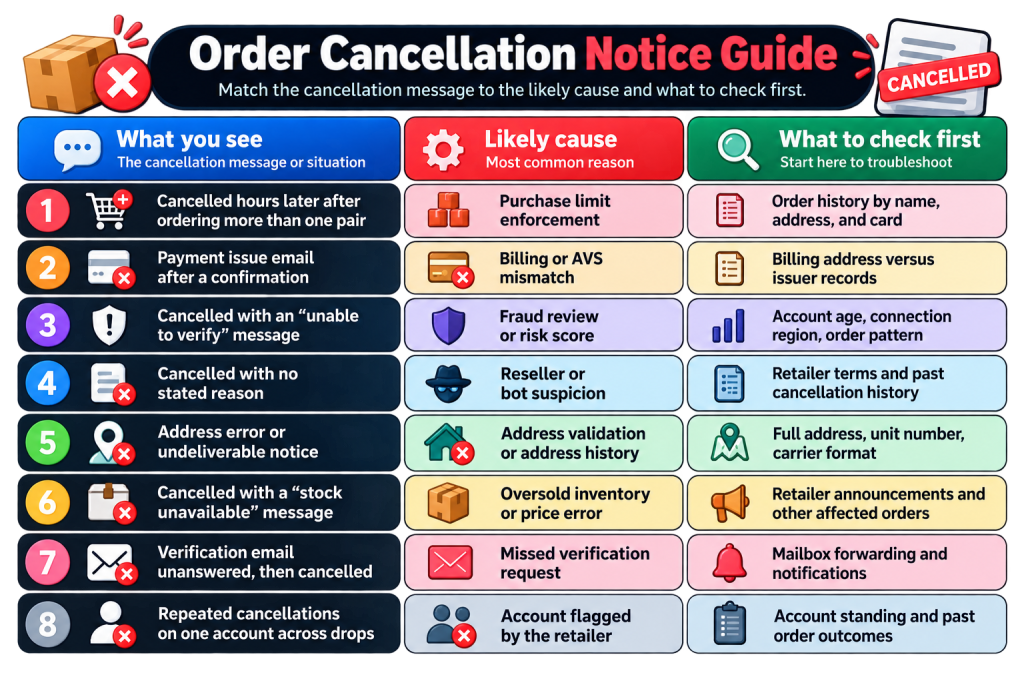
How do I match a cancellation notice to its cause?
A diagnostic table is a lookup that matches a cancellation notice with its most likely cause. Find your notice in the first column, then check the last column first.
| What you see | Likely cause | What to check first |
|---|---|---|
| Cancelled hours later after ordering more than one pair | Purchase limit enforcement | Order history by name, address, and card |
| Payment issue email after a confirmation | Billing or AVS mismatch | Billing address versus issuer records |
| Cancelled with an “unable to verify” message | Fraud review or risk score | Account age, connection region, order pattern |
| Cancelled with no stated reason | Reseller or bot suspicion | Retailer terms and past cancellation history |
| Address error or undeliverable notice | Address validation or address history | Full address, unit number, carrier format |
| Cancelled with a “stock unavailable” message | Oversold inventory or price error | Retailer announcements and other affected orders |
| Verification email unanswered, then cancelled | Missed verification request | Mailbox forwarding and notifications |
| Repeated cancellations on one account across drops | Account flagged by the retailer | Account standing and past order outcomes |
How much do order cancellations cost a botter?
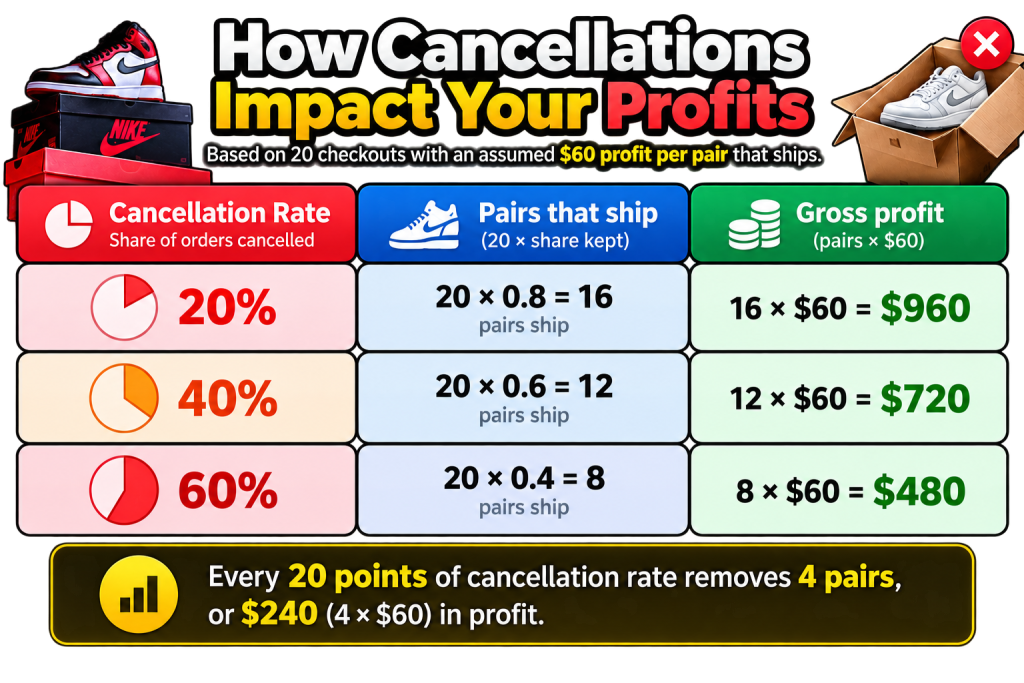
Cancellation cost is the profit you lose on purchases that never ship, and it scales faster than most people expect. The figures below are our own illustration, not retailer data. We assume 20 checkouts across separate authorized accounts, each inside its limit, with an assumed $60 profit per pair that ships.
| Cancellation rate | Pairs that ship | Gross profit |
|---|---|---|
| 20% | 20 × 0.8 = 16 pairs | 16 × $60 = $960 |
| 40% | 20 × 0.6 = 12 pairs | 12 × $60 = $720 |
| 60% | 20 × 0.4 = 8 pairs | 8 × $60 = $480 |
Based on 20 checkouts with an assumed $60 profit per pair that ships. Every 20 percentage points of cancellation rate removes 4 pairs, or $240 (4 × $60) in profit.
Every 20 points of cancellation rate removes 4 pairs, or $240 (4 × $60). That is why we tell people to build cancellations into their margins instead of being surprised by them.
Want to keep a closer eye on your stock and margins? Check out our guide to sneaker reselling inventory management.
A confirmation email is a receipt, not a pair of shoes.
What happens between confirmation and shipping?
Retailers do most of their checks between confirmation and shipping, which is why an order isn’t yours until it ships.
Can a cancelled order be reversed?
Sometimes, if the problem is fixable, like a verification request or an address mistake, and you contact support quickly and politely. Limit and bot-suspicion cancellations are rarely reversed.
How long can a retailer cancel an order after checkout?
It varies a lot. Some land within minutes and others show up a few days later, so assume anything unshipped can still be pulled.
Will I still be charged for a cancelled order?
Usually the charge or authorization is released or refunded, but timing depends on your bank and can take several business days. If it doesn’t clear after that, contact the retailer and your card issuer.
What to remember
- Most cancellations come from eight causes: limits, payment mismatches, fraud scoring, reseller suspicion, address problems, overselling, missed verification, and flagged accounts.
- Treat anything unshipped as still at risk.
- Some cancellations can’t be prevented, so plan margins around them (see the 20%, 40%, and 60% cases above).
- Use only accounts, cards, and addresses you’re authorized to use, and stay inside each retailer’s terms.
Run into a cancellation reason that isn’t on this list? Send it to our support team, and we’ll add it. If you’re scaling up, our guide to buying sneakers in bulk covers how volume changes your risk.
Checkout Isn’t the Finish Line: What Happens After the Cop?
A successful checkout can feel like the finish line, but the order still has to make it from confirmation to your doorstep. Retailer checks and cancellations are part of that bigger picture, which makes understanding what happens after checkout just as important as getting there in the first place. With 1M+ items secured and $50M+ in profit generated by members overall, TSB has plenty of checkout experience behind the numbers.
If you’re building a setup with the full order journey in mind, your TSB key can be one piece you bring along from drop to doorstep.