
Sneaker resale prices often drop after release day as more pairs reach the market and sellers compete for buyers. But that doesn’t happen with every drop. Limited collabs can hold their value or climb higher when demand stays strong. The real question is whether you’re better off flipping immediately or waiting.
Why Do Sneaker Resale Prices Drop After Release Day?
The biggest reason is simple: more supply hits the market.
Before a release, only a few pairs may be available for resale. Buyers who want early access sometimes pay higher prices.
Then release day arrives. People hit on SNKRS, raffles close, and pairs start shipping.
Suddenly, hundreds of sellers compete for the same buyers. Some want quick profits, while others undercut existing listings to move inventory.
That’s when prices can start slipping.
As we explained in our guide to what makes sneakers valuable, scarcity only matters when demand is strong enough to support it.
A sneaker can sell out instantly and still lose resale value afterward.
How Do Prices Change During the First Month?
The first month is often when resale prices experience their biggest adjustments.
Here’s an illustrative example of how a sneaker with a $200 retail price might perform.
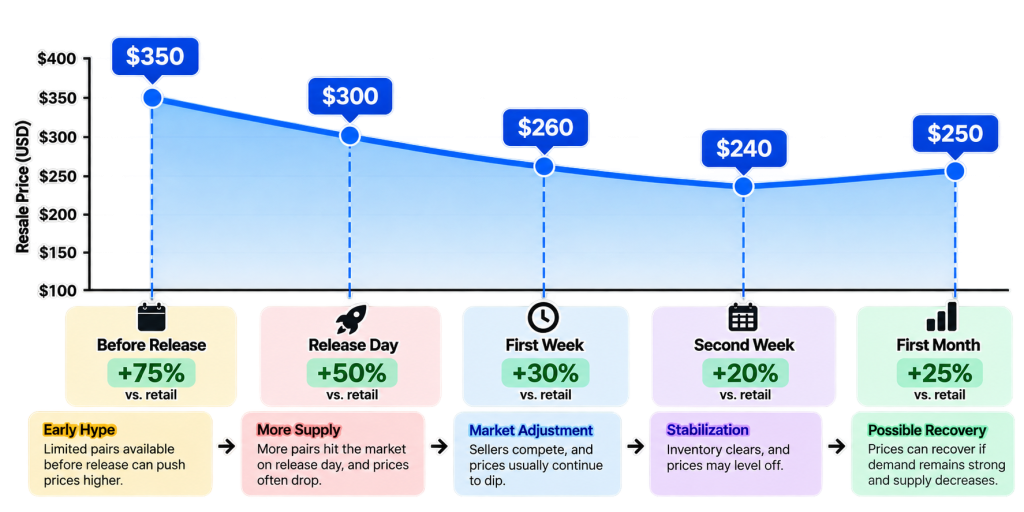
These are hypothetical prices, not historical sales data or a market forecast.
Notice something interesting?
The price doesn’t keep dropping forever. In this example, it recovers slightly after the second week.
That’s possible when sellers clear their inventory, and fewer pairs remain available.
However, other releases continue declining, especially when demand weakens.
Can Sneaker Resale Prices Increase After Release?
Absolutely. Some sneakers become more valuable after their initial release.
This usually happens when buyers continue chasing a pair while available inventory gradually decreases.
Limited collabs, desirable colorways, and culturally relevant releases may benefit from sustained demand.
But don’t confuse limited stock with guaranteed profit.
A sneaker needs actual buyers willing to pay higher prices.
And restocks can change everything.
Our guide explaining why sneaker restocks happen covers how additional inventory becomes available after an initial sellout.
If buyers expect another chance at retail, they may stop paying resale premiums.
Should You Sell Sneakers Immediately or Hold Them?
Your selling decision should depend on current demand, available supply, and your actual profit after expenses.
Let’s say you cop a pair for $200.
You have two possible selling opportunities:
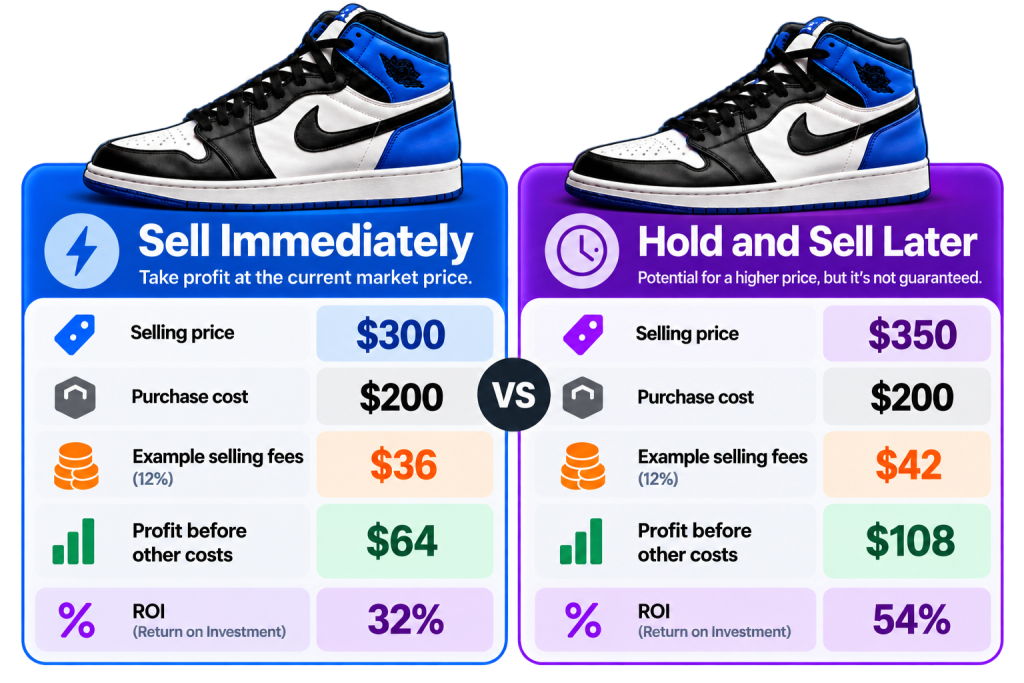
Holding produces an additional $44 in this example.
But there’s a catch.
The $350 future selling price isn’t guaranteed.
Prices could fall below $250 instead, leaving you with considerably less profit.
That’s why our guide on the best time to sell sneakers recommends evaluating demand rather than following a fixed holding period.
How Can You Tell Whether Resale Prices Will Rise or Fall?
You can’t predict every price movement, but you can watch several useful signals.
Before deciding what to do with your pairs, check:
- Recent sales: Are completed transactions increasing or decreasing?
- Listing volume: Are more sellers entering the market?
- Size-specific demand: Does your size command a premium?
- Restock rumors: Could additional inventory affect scarcity?
- Buyer interest: Is demand continuing beyond release-week hype?
Also, don’t rely entirely on asking prices.
Someone listing sneakers for $500 doesn’t mean buyers are actually paying $500.
Completed sales provide stronger evidence of market value.
If you’re building inventory, our sneaker reselling guide for 2026 explains how to approach sourcing and resale research.
Do All Sneaker Sizes Lose Value at the Same Rate?
No. Different sizes can follow different price trends because their supply and buyer demand aren’t identical.
A popular size might maintain its premium while another drops closer to retail.
That’s why checking the overall average resale price isn’t enough.
Always compare recent sales for the exact size you’re holding.
A profitable release doesn’t automatically mean every size delivers the same return.
What Actually Matters After the Drop?
Sneaker resale prices change because supply, demand, and buyer expectations change.
Some pairs peak before release day. Others recover weeks later. Plenty never regain their early premiums.
If you’re reselling, focus on completed sales, fees, restock activity, and how quickly inventory moves.
Copping the sneaker is only half the job, fam.
Knowing when to sell is what determines whether that W actually makes you money.
After the Drop: Where Does the Price Go Next?
A sneaker’s story doesn’t end when release day is over. Prices can rise, dip, or settle as supply, demand, and hype find their balance, which is why understanding the market can matter just as much as understanding the drop.
With 1M+ items secured and $50M+ in profit generated by members overall, TSB has built a track record across plenty of limited releases.
If you’re looking to turn what you know about resale prices into a smarter approach to future drops, your TSB key can be one piece of the setup you bring along for the ride.