
 Sneaker resale profit is what you keep after subtracting all costs from your sale proceeds. ROI goes one step further: it shows profit as a percentage of what you put into the flip.
The key is to calculate from your total cost and actual marketplace payout… not the headline resale price.
How do you calculate sneaker resale profit?
The sneaker resale profit formula is simple:
Net Profit = Net Sale Proceeds − Total Cost
The catch is figuring out those two numbers properly. Your resale price isn’t automatically your proceeds, and the sneaker’s sticker price is not always your total cost.
Say you spend $170 after checkout and allocate $6 of drop-related expenses to that pair. Your cost basis is $176. If the final payout reaching you is $223.80, the calculation is:
$223.80 − $176 = $47.80 profit
That $47.80 is the number worth recording. If you’re just getting started, our sneaker reselling guide covers the wider process from sourcing pairs to selling them.
How do you calculate sneaker resale ROI?
ROI measures how efficiently your money worked.
Use:
ROI = (Net Profit ÷ Total Cost) × 100
Using our example:
($47.80 ÷ $176) × 100 = 27.2% ROI
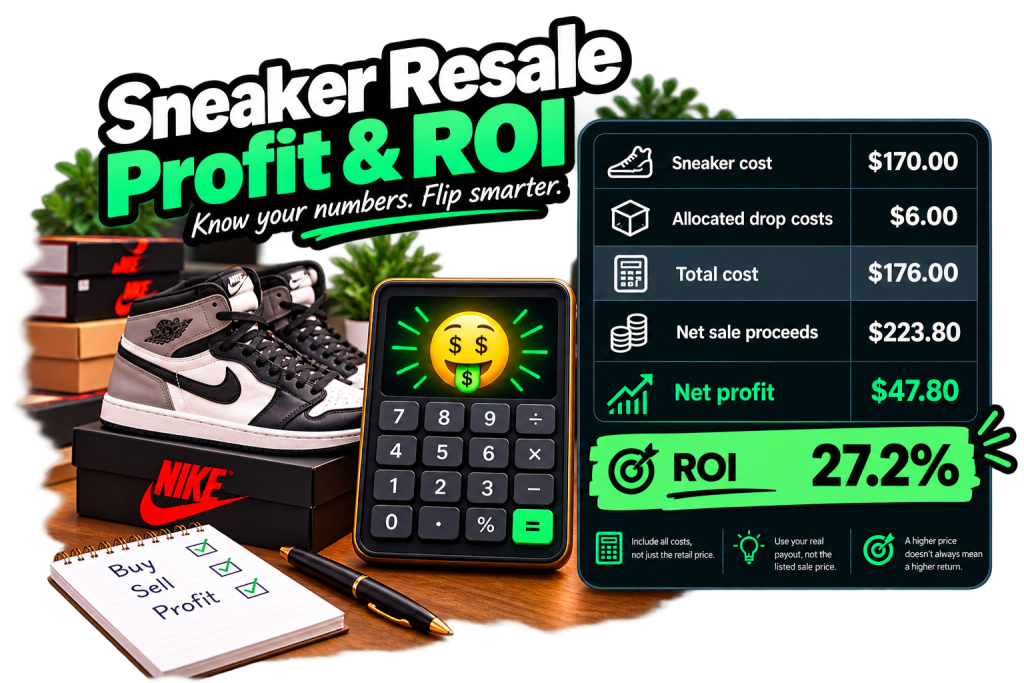
| Sneaker cost | $170.00 |
|---|---|
| Allocated drop costs | $6.00 |
| Total cost | $176.00 |
| Net sale proceeds | $223.80 |
| Net profit | $47.80 |
| ROI | 27.2% |
Include all costs, not just the retail price. Use your real payout, not the listed sale price. A higher price doesn't always mean a higher return.
That distinction matters. A $260 resale on a $170 checkout can look like a $90 W at first glance. It isn’t once the costs between buying and getting paid enter the picture.
Which costs should you include?
Your total cost should include every expense directly tied to getting and selling that pair.
That can mean checkout cost, sales tax, retailer shipping, marketplace fees, seller shipping, packaging, and any other pair-specific expense. Botters should also account for a reasonable share of proxies or other setup costs.
We covered the operational side in our recent guide to managing sneaker reselling stock. Keeping purchase cost and sale info together makes it much harder for a supposed W to turn into an L.
Recurring costs require some judgment. If you bought proxies for several drops, for example, don’t dump the whole bill onto one pair. Allocate the expense consistently across the relevant activity.
How much do selling fees change your profit?
Selling fees can turn a good-looking spread into a pretty average flip, so calculate from the expected payout, not just the listed sale price.
As of October 2026, StockX says its Verified Marketplace Level 1 base transaction fee is 9%, while its payment processing fee is 3%. StockX also announced that standard US seller shipping increased to $5 from March 1, 2026. StockX Rates can differ by seller level, market, selling method, and location, so check the current payout before buying around a projected flip.
That’s also why choosing where and when to exit matters. Our guides to sneaker reselling sites and when to sell sneakers cover those decisions in more detail.
What is a good ROI for sneaker reselling?
A good sneaker resale ROI is one that still makes sense after costs, risk, and the time your cash stays tied up.
There isn’t one percentage that magically makes every pair worth buying. A lower-return flip that sells immediately may be more useful than a higher projected return requiring months of holding. Price can also move while you wait.
That matters in the current market. TSB’s previous resale coverage noted that easy triple-digit flips became less common as the market changed, which makes proper margin tracking more useful than simply chasing hype.
How should you track profit across multiple pairs?
Tracking each pair separately gives you a much cleaner picture of whether your reselling operation is actually profitable.
Record the model, size, purchase date, total acquisition cost, sale price, marketplace, fees, payout, profit, and ROI. If you’re holding inventory, record the sale date too. That tells you not only what made money, but how long your capital was stuck in the pair.
The core calculation stays the same:
Profit = net proceeds − total cost
ROI = profit ÷ total cost × 100
That’s the whole game. Don’t judge a flip by the gap between retail and resale. Judge it by what landed in your pocket compared with what you actually spent.
Knowing how to calculate sneaker resale profit and ROI keeps the math honest. A sneaker can sell well above retail and still produce a weak return. Run the numbers before the drop, update them after the sale, and you’ll know which Ws were actually profitable.
When the Numbers Add Up: Turning a Cop Into ROI
Profit and ROI come down to the numbers, and TSB has a few worth putting on the calculator. With 1M+ items secured and $50M+ in profit generated by members overall, those numbers tell a pretty solid resale story.
If you’re doing the math on your next sneaker opportunity, your TSB key can be one piece of the equation you bring to future drops.