
 A shock drop is a sneaker release that goes live with little or no public advance notice. Instead of giving everyone a normal release date to prepare around, the retailer suddenly makes the pair available, which means finding out about the release and reacting to it become part of the challenge.
The surprise doesn’t necessarily tell you how pairs will be allocated. A shock drop describes when and how the release appears, while FCFS, a draw, a queue, or another launch mechanic can determine what happens after it goes live.
Basically, the shock is the timing. The actual cop still depends on the release system, stock, demand, and whether your purchase makes it all the way through.
What Is a Shock Drop?
A shock drop is an unscheduled or unannounced sneaker release, usually involving a pair people already want badly enough to chase the moment it appears.
That makes it different from the normal release-calendar experience. On a scheduled launch, you may know the date days or weeks ahead. You can set a reminder, prepare your account, and be sitting there before the release starts. A shock drop takes most of that preparation window away.
TSB covered the same basic idea in its older guide to SNKRS shock drops, but the important distinction is worth tightening up: “shock drop” describes surprise availability, not one universal checkout method.
Sneaker releases can use different systems once they are live. TSB’s newer guide to sneaker release methods explains how FCFS releases, raffles, and queues handle demand differently.
So yeah, a surprise release can catch you sleeping. But seeing it quickly is only step one.
How Do Shock Drops Work?
Shock drops work by making inventory available before shoppers have received the usual public release schedule or normal amount of warning.
A simplified release can look like this:
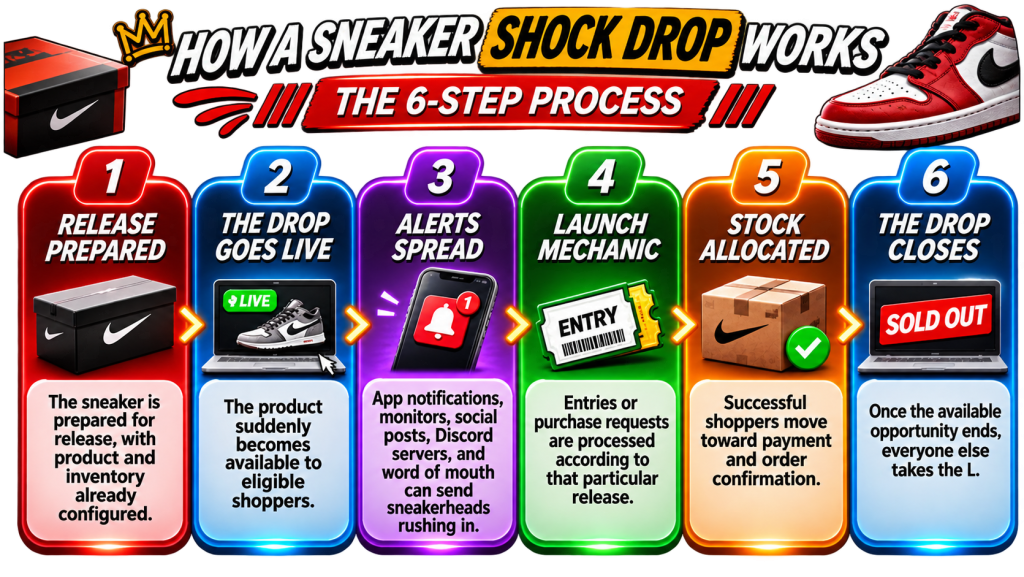
- Release Prepared: The sneaker is prepared for release, with product and inventory already configured.
- The Drop Goes Live: The product suddenly becomes available to eligible shoppers.
- Alerts Spread: App notifications, monitors, social posts, Discord servers, and word of mouth can send sneakerheads rushing in.
- Launch Mechanic: Entries or purchase requests are processed according to that particular release.
- Stock Allocated: Successful shoppers move toward payment and order confirmation.
- The Drop Closes: Once the available opportunity ends, everyone else takes the L.
The whole sequence can feel ridiculously fast from the shopper’s side.
But a release appearing suddenly doesn’t mean the retailer built it five minutes earlier. The surprise is for the public. The inventory, product page, payment flow, and release infrastructure still have to exist behind it.
Are Shock Drops Completely Random?
Shock drops are unexpected to shoppers, but “unexpected” doesn’t mean the retailer randomly decided to release the shoe seconds before it appeared.
Behind the scenes, a release still requires inventory, a product listing, launch configuration, and a system capable of accepting purchase requests or entries. What sneakerheads usually lack is public confirmation of the exact launch time.
And rumors complicate things.
Cook groups, monitors, social accounts, leaks, and sneaker news sources can sometimes point toward a possible surprise release before it happens. That may make a supposedly secret drop feel pretty obvious to people who live in sneaker Discord all day, while the average SNKRS user knows absolutely nothing about it.
That doesn’t turn every rumor into a confirmed drop.
A useful rule is to separate information from confirmation. A rumor can tell you to pay attention. The retailer actually making the product available is what confirms the release.
Shock Drop vs Regular Drop vs Restock
A shock drop, scheduled release, and restock can all put sneakers on sale, but they describe different situations.
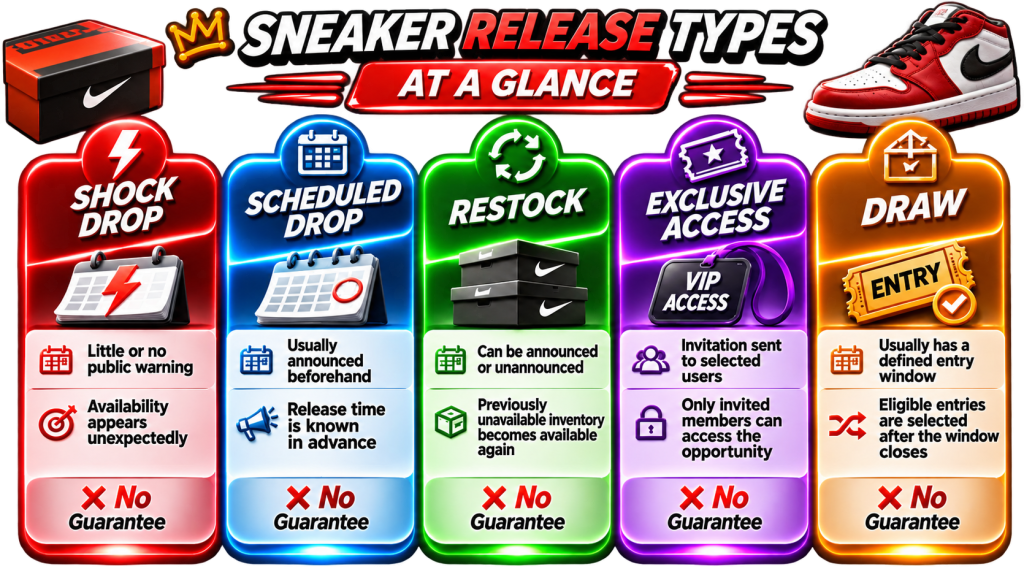
| Release type | How it works | Guarantee |
|---|---|---|
| Shock Drop | Little or no public warning. Availability appears unexpectedly. | No guarantee |
| Scheduled Drop | Usually announced beforehand. Release time is known in advance. | No guarantee |
| Restock | Can be announced or unannounced. Previously unavailable inventory becomes available again. | No guarantee |
| Exclusive Access | Invitation sent to selected users. Only invited members can access the opportunity. | No guarantee |
| Draw | Usually has a defined entry window. Eligible entries are selected after the window closes. | No guarantee |
The biggest confusion is between shock drops and restocks.
A restock is about inventory returning after an earlier release or sellout. It can itself happen without much warning, but that doesn’t make every restock identical to a planned shock drop.
TSB’s guide to how sneaker restocks work explains the distinction in more detail.
Is a SNKRS Shock Drop FCFS or a Draw?
A SNKRS shock drop shouldn’t automatically be treated as FCFS just because it appeared without warning. The surprise timing and the launch mechanic are two separate parts of the release.
Nike publicly describes different SNKRS mechanics. Its SNKRS 101 material describes a Draw as a random-selection launch where winners are selected after the entry window closes. It describes Line differently, where earlier participation improves your chances of finding your size and pair.
That means “I entered first” doesn’t have the same meaning under every launch method.
TSB’s current Nike SNKRS Draw guide follows the draw process from submitted entry to selection and result. Its sneaker queue explainer makes a similar point for waiting systems: getting into the process isn’t the same as securing inventory.
The practical lesson is simple. First identify the release mechanic. Then decide how much speed actually matters.
A fast reaction gets you to the door. The system behind that door decides what happens next.
How Do You Find Out About Shock Drops?
Finding shock drops is mostly an information-speed problem because there may be no normal release date sitting in your calendar beforehand.
Nike recommends keeping an eye on the SNKRS Feed and Upcoming section and enabling app push notifications for releases. Those are sensible basics, but sneakerheads chasing unexpected launches often build a wider information setup around them.
That can include:
- Official retailer apps and notifications
- Brand and retailer social accounts
- Sneaker news sources
- Cook groups
- Discord alerts
- Product and inventory monitors
TSB’s guide to sneaker monitors explains how monitoring tools watch stores for product uploads, restocks, shock drops, queue openings, hidden links, and inventory changes.
The advantage is obvious. Manually refreshing a store all day is miserable.
A monitor can notice a relevant change while you are doing something else. But getting the alert still doesn’t mean the pair is yours.
Do Notifications Guarantee You Will Catch One?
No. A notification tells you something happened. It doesn’t reserve inventory, guarantee entry, or guarantee that the alert reached you before everyone else.
There are several delays between a release happening and you reacting to it.
A monitoring system has to detect the change. An alert has to be sent. Your device has to receive it. You have to notice it. Then you still need to open the release and complete whatever process the retailer requires.
So alerts matter, especially when a release is unexpected. Just keep the distinction clean: fast information gives you a chance to participate. It doesn’t give you the sneaker.
How Should You Prepare for a Shock Drop?
Shock-drop preparation means fixing the boring stuff before the exciting stuff happens.
You cannot control when an unexpected release appears, but you can avoid discovering at the worst possible moment that your password is wrong, your card expired, or your shipping information still points to an apartment you left six months ago.
Before chasing releases, check:
- Your retailer account is accessible
- Your correct shipping address is saved
- Your payment information is current
- Your preferred size is correct
- Relevant app notifications are enabled
- Your release information sources are working
- You understand the retailer’s current launch rules
That last point matters more than people think.
A shock drop can still use a draw, queue, or another release system. TSB’s release-method guide is useful here because blindly treating every surprise release like a speed race can lead you to misunderstand what the retailer is actually doing.
Preparation cannot guarantee a W. It can remove avoidable Ls.
Can Sneaker Bots Work on Shock Drops?
Sneaker bots can automate supported parts of a release workflow, but a bot doesn’t magically create inventory or guarantee that an entry or checkout will succeed.
TSB historically became popular because limited releases create repetitive tasks around monitoring, accounts, product access, and checkout. For TSB specifically, the Nike task configuration guide includes a ShockDrop Mode for releases that qualify as shock drops, provided the account is set to Humanize Mode.
That’s different from saying every surprise release works identically.
The retailer, region, account state, launch mechanic, anti-bot systems, and available inventory can all affect what happens. TSB’s guide to how sneaker bots work explains the wider automation process.
There is also no honest “X tasks = Y pairs” equation.
Even with automation, a shock drop remains a limited release. The bot can automate supported actions. It cannot promise stock that is not there or force a retailer to accept an order.
Is Exclusive Access the Same as a Shock Drop?
No. Exclusive Access and shock drops can both feel unexpected, but they describe different release conditions.
Nike defines Exclusive Access as an invitation to access certain products outside regular launches. Only selected members receive that opportunity. Nike also says receiving Exclusive Access doesn’t mean a pair is reserved in your size.
A shock drop is broader. The defining feature is that the release becomes available with little or no normal public warning. It doesn’t automatically mean access is restricted to a preselected group.
Here is the clean distinction:
Shock drop: surprise timing.
Exclusive Access: restricted invitation.
Different surprise, different mechanic.
Can a Shock Drop Affect Resale Prices?
A shock drop can affect resale prices because it can change the number of pairs entering the market, but the direction and size of that change depend on supply and demand.
Imagine a hypothetical sneaker trading for $350 before an unexpected release. If the shock drop puts a meaningful amount of additional inventory into buyers’ hands, some early sellers may lower their asking prices as more pairs reach resale platforms.
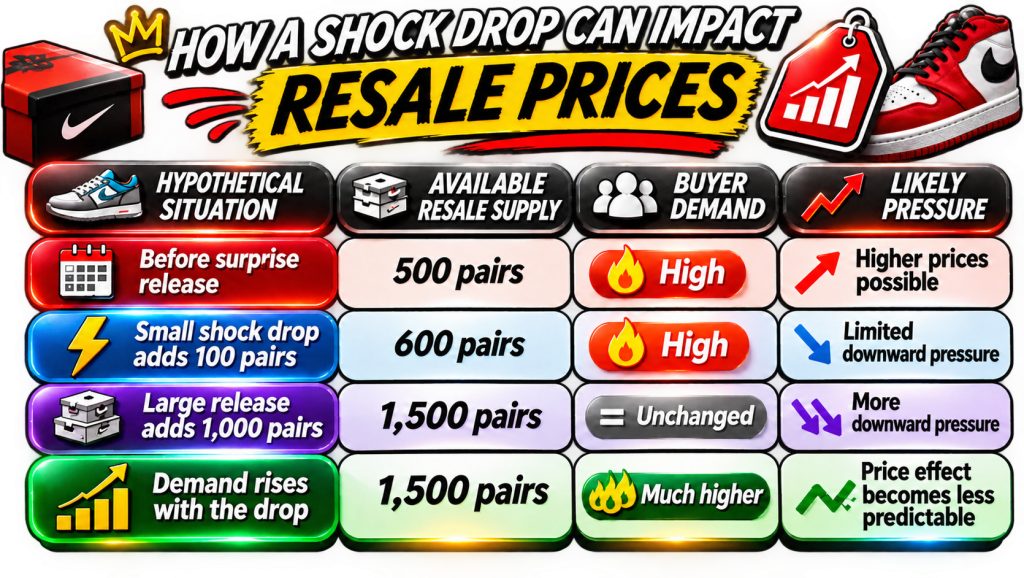
| Hypothetical situation | Available resale supply | Buyer demand | Likely pressure |
|---|---|---|---|
| Before surprise release | 500 pairs | High | Higher prices possible |
| Small shock drop adds 100 pairs | 600 pairs | High | Limited downward pressure |
| Large release adds 1,000 pairs | 1,500 pairs | Unchanged | More downward pressure |
| Demand rises with the drop | 1,500 pairs | Much higher | Price effect becomes less predictable |
Those numbers are illustrative, not historical market data.
TSB’s guide to how sneaker resale prices change after release explains the broader relationship.
What Actually Matters When a Shock Drop Goes Live?
A shock drop rewards preparation and fast information, but understanding the release mechanic matters just as much as hearing about it quickly.
The useful sequence is pretty simple:
Find out → identify the release method → enter or purchase correctly → wait for confirmation.
Don’t turn “shock drop” into a magical category where all the normal release rules disappear. Inventory can still run out. Draws can still end in an L. Queues can still move without leaving stock in your size. Payments can still fail. Retailers can still cancel orders after checkout.
Shock drops feel chaotic because the warning disappears. The underlying lesson is much calmer.
Know how releases work before the surprise one arrives.
Expect the Unexpected: The Real Story Behind Shock Drops
Shock drops are unpredictable by nature, and that element of surprise is exactly what makes them such an interesting part of sneaker culture. TSB has been around for plenty of twists and turns across limited releases, with 1M+ items secured and $50M+ in profit generated by members overall.
If shock drops are another part of the sneaker game you’re getting to know, your TSB key can be one piece of the setup you bring along for whatever the release calendar has in store.