
 Sneaker proxies get banned or blocked when a retailer decides the traffic behind an IP looks risky, automated, or abusive. A bad IP reputation can cause it, but so can sending too many requests, using a concentrated proxy subnet, or pairing a clean IP with a session that still looks like bot traffic.
That’s why replacing a blocked proxy doesn’t always solve the problem. The IP is only one part of what the site sees.
Why does IP reputation get sneaker proxies blocked?
IP reputation is basically the history and risk attached to an IP address. Two proxies can have similar speed and ping while getting completely different results on the same site.
An address that has already generated suspicious traffic can attract more scrutiny. This matters with shared pools because you usually don’t control what previous users did with an IP before it reached you.
We covered the mechanics in our IP reputation guide. The practical point is simple: a proxy being online doesn’t mean it’s useful for a specific retailer.
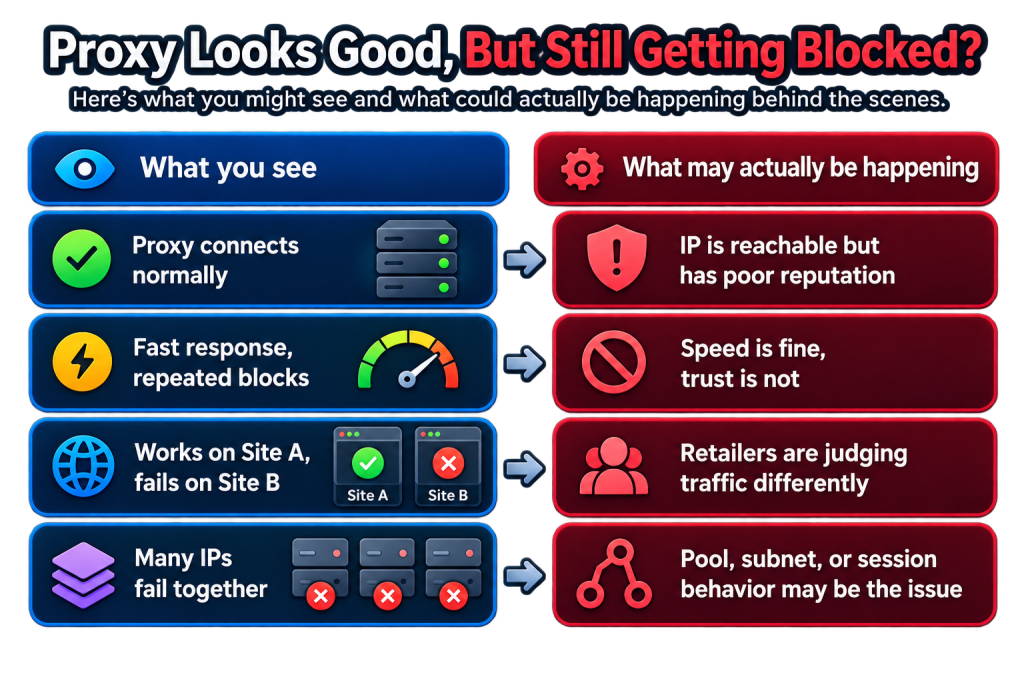
| What you see | What may actually be happening |
|---|---|
| Proxy connects normally | IP is reachable but has poor reputation |
| Fast response, repeated blocks | Speed is fine, trust is not |
| Works on Site A, fails on Site B | Retailers are judging traffic differently |
| Many IPs fail together | Pool, subnet, or session behavior may be the issue |
That last one is why testing against the actual target matters more than a generic proxy speed test.
Can too many requests burn a good proxy?
Yes. A clean IP can become far less useful when the traffic coming through it’s too aggressive. Retailers can rate-limit requests and use traffic patterns to detect bots.
Imagine 40 tasks sharing 10 proxies. That works out to an average of four tasks per proxy before differences in task timing or retries are even considered. If those tasks repeatedly hammer the same endpoints, rotating through 10 addresses doesn’t suddenly make the traffic look normal.
This is also why raw milliseconds are a poor way to judge a pool. A 300 ms proxy that keeps a usable session can be worth more than a 100 ms one that gets challenged constantly.
Our proxy speed vs. success rate guide goes deeper into that trade-off.
Does subnet diversity affect proxy bans?
Subnet diversity matters because a large proxy list can contain addresses that are much more closely related than the raw IP count suggests. Owning 100 addresses doesn’t necessarily mean you have 100 completely independent network identities.
A subnet groups IP addresses within a shared network range. If much of your pool sits inside a narrow range, failures across that range can make a supposedly large pool feel very small during a drop.
We explain the networking side in our proxy subnet guide. You don’t need to obsess over subnet math every time you buy proxies, but it’s worth checking when a big chunk of a pool starts failing at once.
Subnet diversity isn’t a guaranteed fix either. A diverse pool with poor reputation or messy task behavior can still get blocked.
Are residential proxies harder to block?
Residential proxies can look different from datacenter traffic, but “residential” doesn’t mean undetectable. Modern anti-bot systems can use several signals instead of making a decision from IP type alone.
Cloudflare documents detections for traffic associated with residential proxy networks, while DataDome lists residential proxies among the proxy categories its threat-detection systems can identify.
That matters because proxy type is only one variable. A residential IP with suspicious request patterns, inconsistent sessions, or other automation signals can still run into challenges.
So we wouldn’t judge a pool by the residential label alone. Look at how it performs on the retailer you actually care about, how stable the sessions are, and whether failures appear isolated or pool-wide.
For the broader setup, our guide to the best proxies for sneaker sites covers the main proxy types and where each fits.
What if changing proxies doesn’t fix the block?
If fresh proxies keep producing the same result, the problem may sit somewhere else in the session. Retailers and anti-bot providers can evaluate browser, network, request, and behavioral signals together.
Cloudflare, for example, documents multiple bot-detection engines that use signals including machine learning, JavaScript detections, heuristics, and network-level information. That makes an IP swap only one change inside a much larger request.
This is where constantly blaming the proxy pool gets expensive. If several clean-looking pools fail in the same way, check the rest of the setup before buying another batch.
We covered those other signals in how sneaker websites detect bots.
The useful way to diagnose sneaker proxy blocks is to look for patterns. One dead IP points toward the address. An entire subnet failing suggests something broader. Multiple unrelated pools failing on the same setup is a good reason to stop blaming the proxies first.
When the Route Gets Blocked: Understanding the Road Ahead
Proxy bans and blocks are a reminder that not every route through a sneaker drop stays open, and understanding why those roadblocks appear is part of getting to know how the whole setup works. With 1M+ items secured and $50M+ in profit generated by members overall, TSB has been around the block when it comes to sneaker drops.
If proxies are one part of the sneaker botting map you’re learning to navigate, your TSB key can be another piece of the puzzle you bring along for the journey.