
Sneaker queues are virtual waiting systems that retailers use to manage traffic during busy drops. Instead of letting everyone check out simultaneously, they hold or process purchase requests in stages. But here’s the catch: getting into a queue doesn’t mean you’ve secured your sneakers.
Ever watched a hyped release go live, clicked through, and landed on a waiting screen instead of checkout? Yeah, we’ve all been there.
So what’s actually happening behind that screen, and why do some sneakerheads get through while others take the L?
Why Do Sneaker Websites Use Queues?
Sneaker queues help retailers control how many shoppers can access a website or checkout process at once.
When thousands of people chase the same limited release, letting everyone through simultaneously can put pressure on the store’s systems.
A queue helps manage that demand by controlling access or processing requests.
Here’s what can happen during a busy drop:
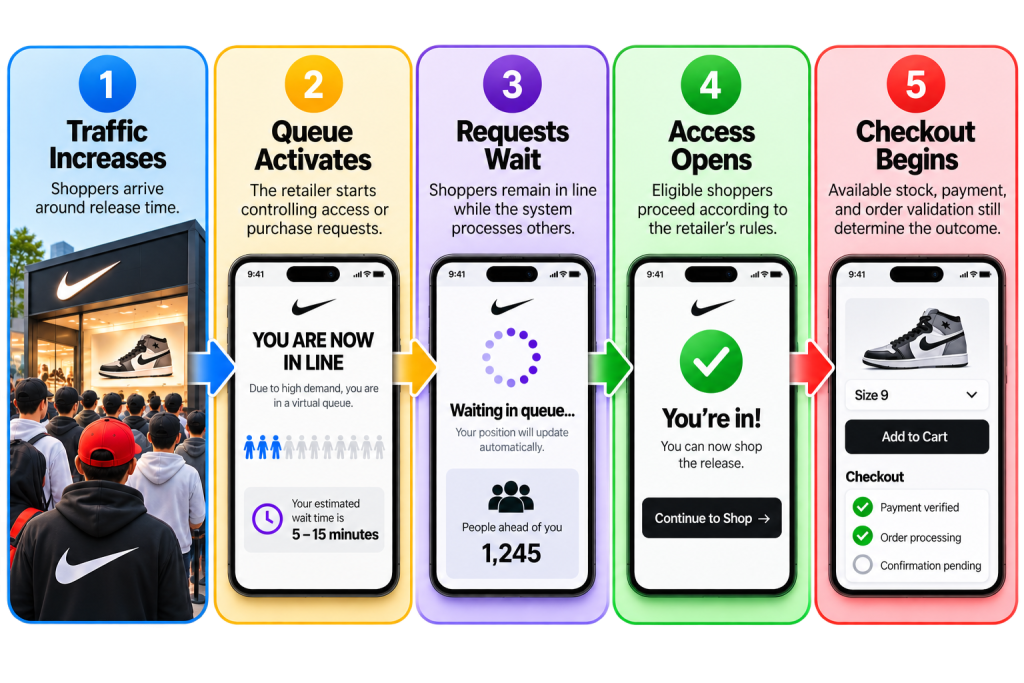
- Traffic Increases: Shoppers arrive around release time.
- Queue Activates: The retailer starts controlling access or purchase requests.
- Requests Wait: Shoppers remain in line while the system processes others.
- Access Opens: Eligible shoppers proceed according to the retailer's rules.
- Checkout Begins: Available stock, payment and order validation still determine the outcome.
Not every release follows this exact sequence.
Our guide to sneaker release methods explains how queues differ from FCFS drops and raffles.
What Happens When a Sneaker Queue Gets Busy?
A busy sneaker queue means more shoppers are waiting than the retailer is currently allowing through.
That doesn’t necessarily mean the website has crashed.
Some systems deliberately slow access to keep checkout manageable. Others process purchase requests according to release-specific rules.
Here’s a simplified example.
Imagine 1,000 shoppers entering a queue while the system admits 100 shoppers per minute.
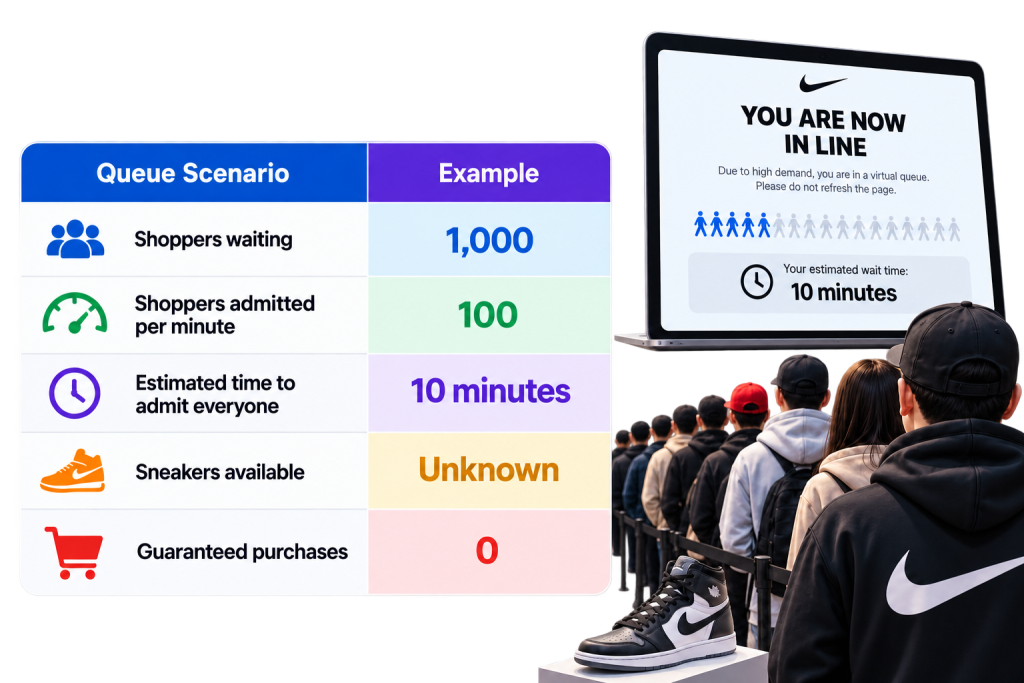
| Queue Scenario | Example |
|---|---|
| Shoppers waiting | 1,000 |
| Shoppers admitted per minute | 100 |
| Estimated time to admit everyone | 10 minutes |
| Sneakers available | Unknown |
| Guaranteed purchases | 0 |
The 10-minute estimate is a mathematical illustration, not an actual retailer benchmark.
Real queue speeds can change, and admission doesn’t guarantee inventory.
Does Your Queue Position Guarantee Sneakers?
No. Your queue position tells you something about your place in the waiting process, not whether you’ll successfully purchase a pair.
Stock can disappear before your request reaches checkout.
Nike’s official SNKRS guidance also describes a different system for certain launches.
According to Nike’s launch guidance, some releases place requests into a processing queue, group them, and select winning requests through drawings.
That means reaching the processing stage isn’t automatically a W.
The distinction matters because queue admission, purchase selection, and confirmed checkout are separate outcomes.
How Long Do Sneaker Queues Usually Last?
Sneaker queue times depend on traffic, retailer rules, processing capacity, and release conditions.
There’s no universal waiting time.
A smaller drop might move quickly, while a hyped release could leave shoppers waiting considerably longer.
Even an estimated wait isn’t necessarily fixed.
The important part? A long wait doesn’t prove that stock remains available.
Should You Refresh While Waiting in a Sneaker Queue?
Refreshing isn’t a universal solution, and some waiting systems specifically advise against it.
Whether refreshing affects your position depends on the retailer’s implementation.
Follow the instructions displayed on your queue page rather than assuming repeated refreshes will help.
Before release time, it’s also worth checking:
- Your account login
- Saved shipping information
- Payment details
- Correct sneaker size
- Retailer’s release instructions
These preparations reduce avoidable checkout problems, although they won’t guarantee a successful purchase.
Can Sneaker Bots Help With Busy Queues?
Sneaker bots automate certain release tasks, but their capabilities depend on the retailer and its checkout system.
For example, TSB’s sneaker bot guide explains how automation can handle monitoring, account actions, and supported checkout workflows.
However, automation doesn’t guarantee queue priority, available stock, or successful checkout.
Retailers may also restrict automated purchasing.
Understanding the release system matters more than assuming every queue works the same way.
Can You Get Through a Queue and Still Take an L?
Absolutely.
Getting through a sneaker queue means you’ve reached the next stage of the purchasing process.
You might still run into unavailable sizes, payment failures, checkout errors, or an unsuccessful purchase selection.
That’s why a waiting screen disappearing isn’t the same as receiving an order confirmation.
For sneakerheads chasing hyped releases, the real W comes when the retailer successfully confirms the purchase.
Bottom line: Sneaker queues manage busy drops, but they don’t reserve sneakers for everyone waiting. Know the release rules, prepare your checkout details, and remember that getting through the queue is only part of the process.
When the Line Gets Long: What Really Matters?
A busy sneaker queue can feel like a traffic jam, but understanding what happens behind the scenes makes the wait less mysterious. And when it comes to navigating limited releases, TSB has built a track record of its own, with 1M+ items secured and $50M+ in profit generated by members overall.
If sneaker queues are just one more piece of the release-day puzzle you’re learning to navigate, your TSB key can be another part of the setup you bring along for the ride.