
Sneaker release types tell you how widely a pair is distributed and who it was originally made for. GR means General Release, QS means Quickstrike, PE usually means Player Exclusive or Player Edition, and F&F means Friends & Family. You also have even scarcer labels like Hyperstrike, plus terms such as SE and SMU that describe special sneaker versions.
And these labels matter. A GR sitting at several retailers is a very different cop from a PE that was never intended to hit retail.
What Does GR Mean in Sneakers?
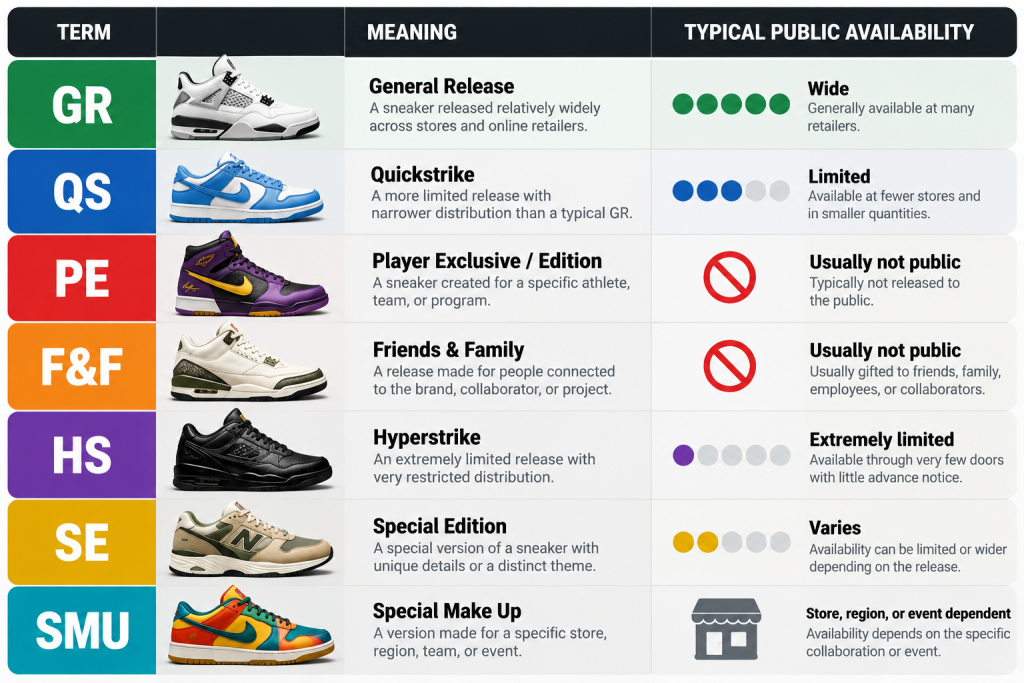
GR means General Release, a sneaker released relatively widely across stores or online retailers.
Think of GRs as the accessible side of sneaker releases. They are generally produced and distributed more broadly than limited editions, although a GR can absolutely still sell out. Wide release does NOT mean unlimited stock.
That distinction also matters for resale. More available supply can reduce scarcity, which is why repeated availability can change how a sneaker performs after release. We broke down that supply effect further in our guide to sneaker restocks.
For a recent example, the Air Jordan 4 “Birds of Paradise” was positioned as a general release through SNKRS and select Jordan retailers.
What Does QS Mean in Sneakers?
QS means Quickstrike, a more limited sneaker release that receives narrower distribution than a typical GR.
The term is especially associated with Nike. QS pairs historically sit on the scarcer side of retail releases, with fewer stores or quantities involved than you would normally expect from a General Release.
But QS describes the sneaker’s type or distribution, not necessarily the checkout system used to sell it. A limited pair could still launch through a raffle, queue, or another system. Our sneaker release methods guide explains that difference.
And once you get into QS and other limited drops, release terminology is only part of the equation. Competition, retailer systems, and automation can affect your actual chances of checking out. If you’re wondering where bots fit into all this, our guide to how sneaker bots actually work breaks down what they can and can’t do on competitive releases.
What Does PE Mean in Sneakers?
PE means Player Exclusive or Player Edition, referring to sneakers created for a particular athlete, team, or program.
These are the pairs you spot on court and immediately start wondering where you can cop them. Usually, you can’t.
PEs can feature unique colors, athlete-specific branding, numbers, or other details that separate them from retail versions. Some also remain genuinely exclusive, while designs that began as PEs can occasionally inspire or become public releases later.
So, PE doesn’t automatically mean “exactly one pair exists.” It tells you who the sneaker was created for… not a guaranteed production number.
A good 2026 example is Nike’s EYBL PE sneakers, including the Ja 4 EYBL PE, which had no confirmed public release when we covered it.
What Does F&F Mean in Sneakers?
F&F means Friends & Family, a release made primarily for people connected to the brand, collaborator, designer, or project, rather than normal retail customers.
That makes F&F pairs some of the hardest sneakers to acquire through regular channels. They may be gifted to friends, family members, employees, collaborators, or other people involved with a project instead of receiving a conventional public drop.
Occasionally, an F&F pair later reaches consumers through giveaways or unusual promotions. That doesn’t turn every F&F sneaker into a public release, though. The label still describes its original intended distribution.
For real examples, we’ve covered eight F&F sneakers, including F&F Dunks and Jordans that rarely reach normal retail channels.
What Does Hyperstrike Mean?
A Hyperstrike, often shortened to HS, is an extremely limited release with very restricted distribution and little advance notice.
Basically, take the scarcity associated with a QS and crank it up. The term has historically been associated with particularly scarce Nike releases available through very few doors.
This is also where sneaker terminology gets messy. Terms can overlap, evolve, or be used loosely by sneakerheads and retailers. They are better treated as distribution labels than exact stock-count formulas.
What Does SE Mean in Sneakers?
SE means Special Edition, a version of a sneaker that usually gets distinctive colors, materials, details, or a theme that separates it from the standard model.
But SE doesn’t automatically mean ultra-rare. Availability depends on the specific release. A recent example is the Air Max 95 Convini Pack, a special-edition pack inspired by Japanese convenience-store culture.
What Does SMU Mean in Sneakers?
SMU means Special Make Up, referring to a sneaker produced for a particular retailer, market, team, event, or other specific purpose.
Unlike GR or QS, SMU doesn’t tell you exactly how scarce the sneaker is. Distribution depends on why that particular version was created and who it was made for.
Is a Release Type the Same as a Release Method?
No. Release type describes the sneaker’s availability or intended distribution, while release method describes how buyers actually get a chance to purchase it.
A GR, QS, or limited collab tells you something about the pair. FCFS, raffles, queues, Shock Drops, and SNKRS draw formats tell you something about the drop.
Your setup is a third piece of that puzzle. On competitive online releases, buyers may use multiple accounts, proxies, profiles, and automated tasks depending on the retailer and release method. Our sneaker bot setup guide explains how those pieces work together before a drop.
That difference is worth knowing before release day. Check our FCFS vs raffles vs queues guide for the buying side of the equation.
So when someone calls a sneaker GR, QS, PE, F&F, HS, SE, or SMU, you know what they’re telling you about the pair: how widely it was distributed, who it was made for, or both.
Different Drops, Different Doors: Know Which Ones to Chase
From GRs that hit plenty of shelves to QS pairs that disappear in a flash, every release plays by a different set of rules. But when the right public opportunity comes around, being prepared can make all the difference. With 1M+ items secured and $50M+ in profit generated by members overall, TSB has the track record to back the talk.
If the next sneaker gem has a door you can actually walk through, your TSB key can be part of the setup you bring to the drop.